
FAA Part 107 Knowledge Test: How Many Questions, Passing Score, and How to Study from Official Sources
October 30, 2026 · 7 min read · Updated October 31, 2026
If you want to fly small drones commercially in the United States under 14 CFR Part 107, you generally need a Remote Pilot Certificate with a small UAS rating. For many applicants, that means passing the FAA's Unmanned Aircraft General (UAG) knowledge test before you apply.
Search results for "part 107 how many questions" are full of blog summaries. This article uses the FAA's own Airman Certification Standards (ACS), testing matrix, and study FAQ so the numbers you memorize match what the agency publishes.
Short answers
According to the FAA Remote Pilot - Small Unmanned Aircraft Systems Airman Certification Standards (FAA-S-ACS-10B):
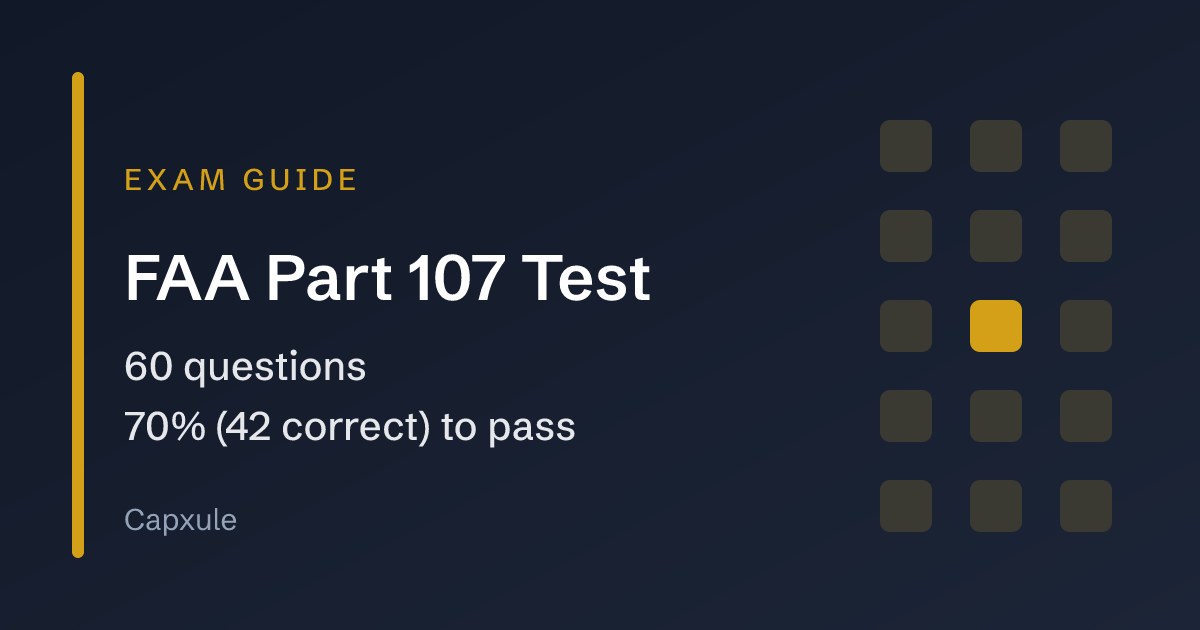
- The certification knowledge test has 60 questions (scored items).
- You need 70% or better to pass (that is at least 42 correct out of 60).
- You have up to two hours to complete the test.
- Questions are multiple choice, with one correct response each, and are independent of one another.
The FAA Airman Knowledge Testing Matrix also notes that knowledge tests may include validation questions used for statistical analysis. Validation questions are not scored and do not count for or against your score. The published "number of questions" does not include those validation items, while the allotted time does include time to answer them. The scored length remains 60 even if the on-screen item count is higher.
The same matrix lists the UAG test as 60 questions, 2.0 hours allotted, and a 70 passing grade.
What topics appear on the test?
The FAA's testing vendor, PSI, publishes the current topic weights in its Unmanned Aircraft General - Small Applicant Information Bulletin (PDF), effective September 29, 2025. They replace the older percentage ranges printed in the ACS appendix:
| Area | Share of items |
|---|---|
| I. Regulations | 48% |
| II. Airspace Classification & Operating Requirements | 20% |
| III. Weather | 5% |
| IV. Loading & Performance | 2% |
| V. Operations | 25% |
| Total scored questions | 60 |
Regulations is now almost half the test, so it deserves the most study time. Operations and airspace come next. Weather and loading are small slices but still tested. PSI says the weights come from an industry-wide job task analysis completed in 2025. The same bulletin lists 5 unscored validation questions on top of the 60 scored ones, with the time allowance covering them.
The ACS organizes knowledge into Areas of Operation that match how the FAA thinks about the certificate: regulations (including operating rules, waivers, operations over people, and remote identification), airspace classification and operational requirements, weather sources and effects, loading and performance, and operations (communications, airports, emergencies, decision-making, physiology, maintenance).
Who needs the knowledge test?
Applicants who do not meet the pathway in 14 CFR Part 107 that allows certain Part 61 certificate holders with a current flight review to complete online training instead must pass the knowledge test before applying for the Remote Pilot Certificate with an sUAS rating. The ACS describes that requirement and points to Appendix material on eligibility and testing centers.
Eligibility highlights published in the ACS include being at least 14 years of age to take the certification knowledge test (with proper identification), and demonstrating the ability to read, write, speak, and understand English under the FAA English Language Standard (with limited medical exceptions as described in advisory material). Always confirm current eligibility in 14 CFR Part 107 and the ACS before you schedule. Do not assume Part 61 airplane medical rules apply unchanged to Part 107.
Where do you take it, and what happens after?
The FAA's testing vendor, PSI Services, operates knowledge testing centers. You register, schedule, and pay through the FAA/PSI channel (the ACS links to https://faa.psiexams.com/faa/login). You need an FAA Tracking Number (FTN) via IACRA to register for airman knowledge tests.
Immediately after the test you receive an Airman Knowledge Test Report (AKTR) with your score. For a passing result used toward the Remote Pilot Certificate, the ACS states the AKTR remains valid for 24 calendar months when you apply. The report also lists ACS codes for missed areas so you know what to review.
If you fail
Under 14 CFR Part 107 as summarized in the ACS:
- You may not retake the knowledge test for 14 calendar days after a failure.
- You must present the AKTR showing the failure when you retest.
- No instructor endorsement is required to retest after failure for this certification knowledge test.
Plan for the 14-day wait and a new appointment through the FAA/PSI registration channel.
Official study materials (free from the FAA)
The FAA FAQ "Where can I find study materials for the Part 107 aeronautical knowledge test?" points applicants to:
- The Airman Certification Standards for Unmanned Aircraft Systems (PDF).
- The Remote Pilot Study Guide (PDF).
- Online sample questions (PDF) for Unmanned Aircraft General (UAG).
Those three should be your baseline. Third-party courses can help with drills, but they are not the standard. If a prep product contradicts the ACS or current 14 CFR Parts 89 and 107, trust the FAA documents.
A study sequence that stays honest to those sources:
- Skim the ACS so you know what "Areas of Operation" and ACS codes mean.
- Read the Remote Pilot Study Guide against Part 107 and Part 89 topics (remote ID appears in the ACS).
- Drill the FAA sample UAG questions and note which ACS areas you miss.
- Spend extra time on Regulations first, then Operations and Airspace (the heavier weights).
- Take full-length timed practice that mirrors 60 scored questions / 70% / two hours.
- On test day, bring acceptable identification as required by the testing matrix and center rules.
Chart and figure questions
Many commercial prep brands emphasize sectional-chart questions. Capxule's Part 107 practice questions are text only, so they do not drill sectional-chart reading with figures. Plan chart practice from FAA chart materials and the Airman Knowledge Testing Supplement that figure questions refer to. Do not assume any single practice bank covers every figure style you might see.
Where Capxule fits
Capxule offers a Part 107 practice test with original questions written from current Part 107 material and FAA study sources, with mock tests following the published 60 questions / 42 correct to pass rule: FAA Part 107 remote pilot test practice.
To study one ACS area at a time, each has its own page listing its ACS tasks: Regulations, Airspace, Weather, Loading and performance, and Operations.
Use it as a drill companion after you have opened the FAA ACS and study guide, not as a replacement for them. Capxule is the context marketplace: handcrafted expert context on one topic, as a journey that stays as a companion. It is not the FAA, and it does not issue certificates.
For more on how capsules work, see What is an AI context capsule?.
Common confusions (answered carefully)
"Why might I see more than 60 items on screen?" Scored length is 60 per the ACS and testing matrix. Extra items can be unscored validation questions; allotted time includes them.
"Is 70% exactly 42?" 70% of 60 is 42. The ACS requires 70% or better.
"Can I retake immediately?" No. The ACS cites a 14-calendar-day wait after failure for this test.
"Do I need a medical certificate like a private pilot?" Follow current 14 CFR Part 107 and ACS eligibility language rather than assuming Part 61 airplane medical pathways apply the same way.
Sources
- FAA, Remote Pilot - Small Unmanned Aircraft Systems Airman Certification Standards (FAA-S-ACS-10B, PDF) - 60 total; two hours; 70% pass; retest after 14 days; FTN/PSI; AKTR valid 24 months.
- PSI, Unmanned Aircraft General - Small Applicant Information Bulletin (PDF) - effective Sep 29, 2025; topic weights (48/20/5/2/25); 5 unscored validation questions.
- FAA, Airman Knowledge Testing Matrix (PDF) - UAG row (60 / 2.0 / 70); validation-question rules.
- FAA, Where can I find study materials for the Part 107 aeronautical knowledge test? - ACS, Remote Pilot Study Guide, sample questions.
- FAA, Unmanned Aircraft General (UAG) Sample Questions (PDF) - sample study material.
Give your AI the context it's missing.
Capxule turns your team's decisions, constraints, and know-how into a capsule any AI tool can use.